Project Details
 UTC Project Information
 Abstract
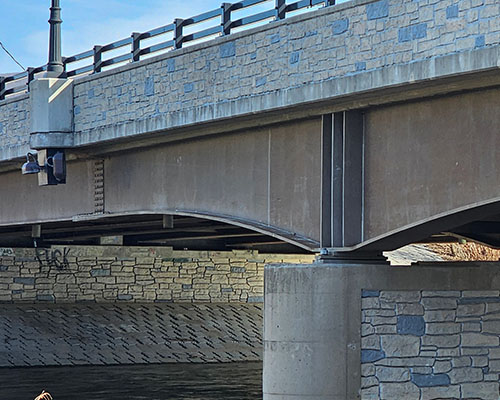 Corrosion is a significant concern for steel bridges, and if not properly designed for or mitigated, can lead to costly maintenance or service failures. One option for making steel bridges more corrosion-resistant is to use 50CR steel (formerly ASTM A1010 steel), which is a stainless steel having similar mechanical properties to typical bridge steels with much greater corrosion resistance. While 50CR steel is attractive due to its corrosion resistance, it’s cost, relative to traditional carbon steel, may preclude it from use due to budgetary restraints. One option for making 50CR steel bridges more cost-effective is by using a dual-grade girder, in which 50CR is used in targeted corrosive locations, while conventional steel, such as uncoated ASTM A709 Grade 50W or coated steel, are used elsewhere. By using the more costly material where it provides the most benefit, dual-grade girders have the potential to achieve life cycle cost savings by reducing future maintenance and increasing the overall service life of the girder. There has been limited research addressing the strength and corrosion performance of 50CR welded to traditional carbon steels. This research will quantify the corrosion behavior and the galvanic corrosion potential through accelerated corrosion tests. Strength tests will also be performed to evaluate any potential issues with the welding processes required for hybrid welding.
Project Word Files
project files
- UTC Project Information (Word, 86K)
Note to project PIs: The UTC document is limited to two pages. Also, it would be helpful if the Track Changes feature is used when editing either document above. Updated documents should be emailed to ndsu.ugpti@ndsu.edu.