Project Details
Seismic Performance of Steel-Concrete Composite Bridge Piers
 UTC Project Information
 Abstract
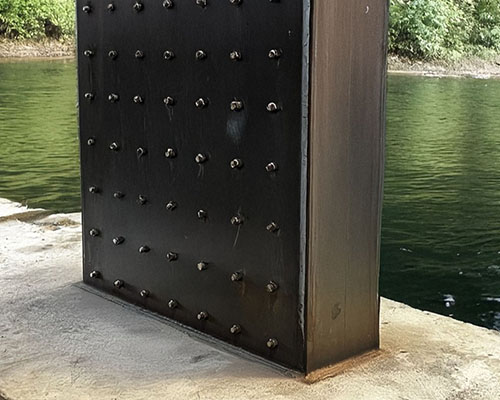 Traditional cast-in-place reinforced concrete (RC) bridge piers, while common, involve a slow, multi-stage construction process that elevates project costs and poses significant safety risks to both workers and traffic within construction zones. As an innovative alternative, steel-concrete composite structural systems offer a substantial reduction in construction time—estimated at up to 40%—thereby enhancing project schedules and safety. However, the widespread adoption of this promising technology is currently hindered by a critical lack of knowledge and codified guidance regarding its seismic design and performance.
This research proposal aims to systematically address this gap by investigating the key parameters influencing seismic behavior and developing comprehensive design guidelines for steel-concrete composite bridge piers. The project’s primary objectives include the design of multiple composite pier configurations, the development and validation of detailed 3D nonlinear finite element models using commercial software, and the execution of performance-based seismic assessments to evaluate damage states and failure mechanisms. The methodology will encompass designing piers and their connections to foundations based on existing experimental data, creating sophisticated finite element models that capture material nonlinearities, and conducting extensive pushover analyses under varied conditions (e.g., axial load, reinforcement ratio, cross-sections).
The anticipated outcomes are highly relevant to national strategic goals, including improved seismic resiliency through higher ductility and stiffness, enhanced safety via reduced time in construction work zones, and greater economic efficiency through accelerated project completion. The research will yield advanced numerical modeling techniques, performance-based seismic design methodologies, and practical design recommendations and specifications for structural engineers. These outputs will be disseminated through a final report to the US Department of Transportation (USDOT), peer-reviewed publications, and conference presentations, ultimately contributing to the development of more resilient and rapidly constructed infrastructure. The project also offers significant educational benefits by training students in advanced computational modeling and seismic design, fostering collaboration between academia and industry. The work is planned over a 24-month period, structured into four six-month phases covering literature review and design, model development, seismic analysis, and the formulation of final design guidelines.
Project Word Files
project files
- UTC Project Information (Word, 87 KB)
Note to project PIs: The UTC document is limited to two pages. Also, it would be helpful if the Track Changes feature is used when editing either document above. Updated documents should be emailed to ndsu.ugpti@ndsu.edu.